
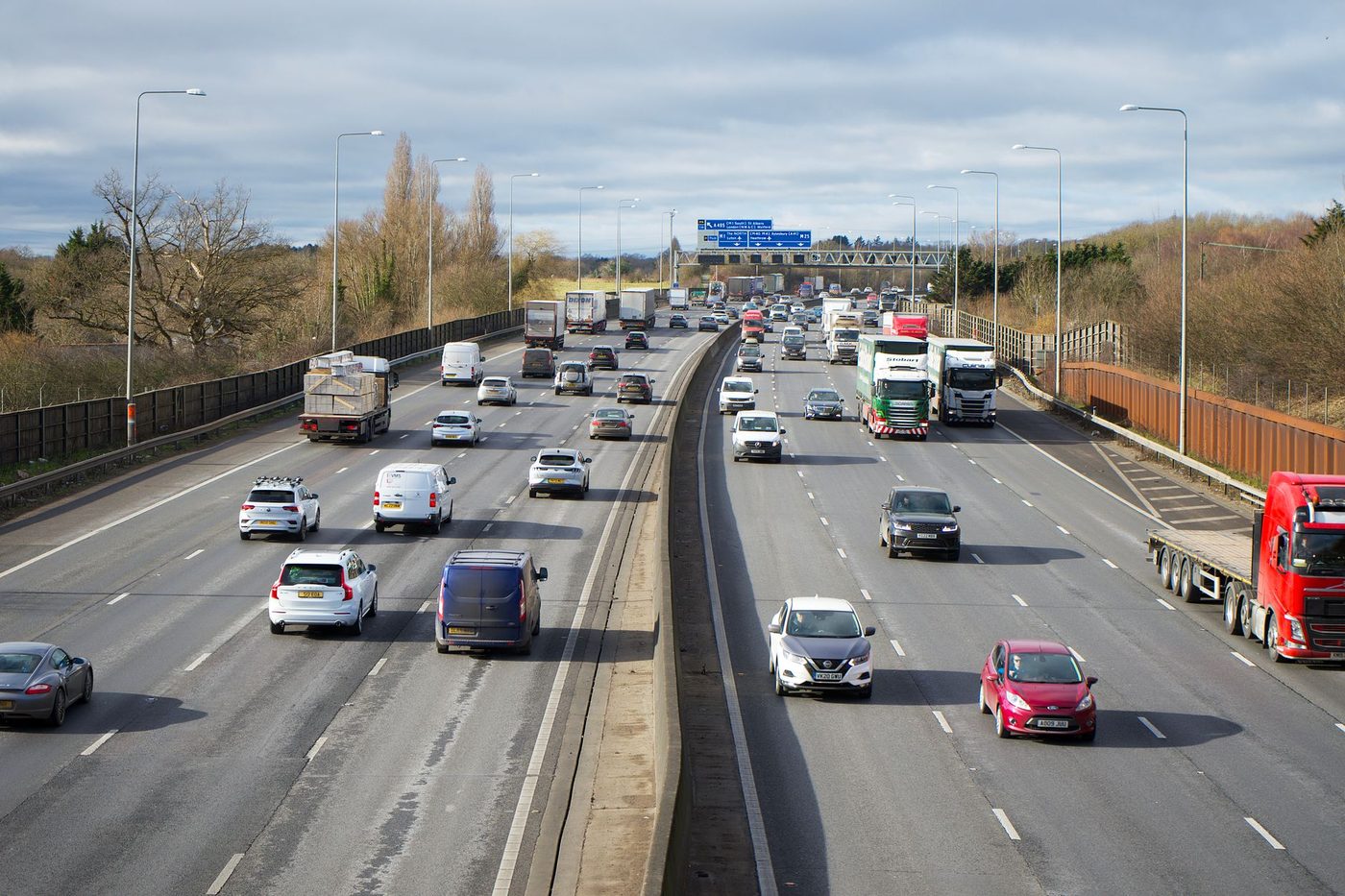
Dual carriageway lessons teach learners to join from a slip road, hold a steady speed in the left lane, overtake and move back, change lanes for an exit and, where the layout allows, turn right across a central reservation. There is no fixed lesson number for a first dual carriageway drive: instructors usually introduce one once you can control the car smoothly at higher speeds on single carriageways and use your mirrors without prompting. Unlike a motorway, which a learner can only use with an approved driving instructor in a dual-control car, a dual carriageway is an ordinary road, so you can also practise on one with an eligible supervisor. The national speed limit for cars on a dual carriageway in Great Britain is 70 mph unless signs show a lower limit.
What makes a road a dual carriageway
The defining feature is the central reservation: a strip, barrier or kerbed island that divides the two directions of traffic. A dual carriageway can have two, three or more lanes each way. It is not a motorway, so learners, cyclists and slower vehicles may use it unless signs say otherwise. Speed limits can be lower than 70 mph where signs show it.
Can learner drivers use dual carriageways?
Yes. The motorway restriction in Highway Code Rule 253 applies only to motorways. On a dual carriageway a learner can practise with an approved driving instructor or with a supervisor who meets the GOV.UK rules (over 21, qualified to drive that type of vehicle and holding a full licence for 3 years). See who can supervise a learner driver.
The rules your instructor will cover
| Situation | What the Highway Code says (summary) | What you practise in lessons |
|---|---|---|
| Two-lane dual carriageway | Rule 137: keep to the left lane; use the right lane to overtake or turn right, then move back left when safe. | Holding the left lane at a steady speed; planned overtakes |
| Three or more lanes | Rule 138: you may use the middle or right lanes to overtake, then return to the middle and then left lane when safe. | Mirror checks and blind-spot checks before each lane change |
| Crossing or turning right across one | Rule 173: first judge whether the central reservation is deep enough to protect your whole vehicle. If it is, treat each half as a separate road; if not, wait until you can cross both in one go. | Judging gaps and the depth of the gap in the reservation |
| Speed | National limit for cars is 70 mph unless signs show a lower limit. | Building up to the limit when conditions allow; reading speed signs |
| Joining from a slip road | General instructor guidance (no specific dual carriageway rule): build speed on the slip road and merge into a safe gap. | Using the slip road to build speed rather than stopping at the end |
For more on turning right across a central reservation and the other junction rules, see what Highway Code rules 170 to 183 say about junctions. Our sister site for test preparation, Get Driving Test Ready, also covers lane discipline on multi-lane roads in more depth.
How instructors build up to dual carriageways
There is no fixed lesson number for a first dual carriageway drive. Instructors usually wait until you can control the car smoothly at higher speeds on single carriageways, use your mirrors without prompting and judge gaps at roundabouts. A typical progression looks like this:
- A quiet dual carriageway at an off-peak time, joining and leaving at the same junctions.
- Sustained driving in the left lane, holding a steady speed and a safe following distance.
- Planned overtakes of slower vehicles, then returning to the left lane.
- Busier stretches, lane changes for exits and roundabouts at each end.
- Turning right across a central reservation, where the road layout allows it.
If dual carriageways near your test centre are busy, ask your instructor to include them in a mock test. DVSA does not publish test routes, but higher-speed roads can come up in the independent driving part of the test.
Common mistakes on dual carriageways
- Driving too slowly in the left lane, which can cause other drivers to overtake unsafely.
- Staying in the right lane after overtaking.
- Stopping at the end of a slip road when there is a safe gap.
- Late signals and lane changes for an exit.
- Following too closely at higher speeds. See the two-second gap and stopping distances.
Frequently asked questions
What is the speed limit on a dual carriageway?
For cars and motorcycles in Great Britain it is 70 mph unless signs show a lower limit. Lower limits apply to some vehicles, such as those towing.
Is a dual carriageway the same as a motorway?
No. Motorways have their own rules and learners may only use them with an approved driving instructor in a dual-control car. Dual carriageways are ordinary roads with a central reservation.
Can I practise on a dual carriageway with a parent?
Yes, if they meet the supervisor rules and you are insured. See learner driver insurance.
Which lane should I use on a dual carriageway?
The left lane, unless you are overtaking or turning right. Return to the left when it is safe.
Nervous about faster roads? Compare instructors near you and ask how they introduce dual carriageways.
The bottom line
A dual carriageway is an ordinary road with a central reservation, usually with a 70 mph limit for cars, and learners can use one with an instructor or an eligible supervisor. Keep left unless overtaking or turning right, check mirrors and blind spots before every lane change, and judge the depth of the central reservation before crossing. Most instructors build up from quiet stretches to busier ones well before the test.
Sources
- The Highway Code, rules 103 to 158 (gov.uk) (Rules 137 and 138)
- The Highway Code, rules 159 to 203 (gov.uk) (Rule 173)
- The Highway Code, rules 253 to 273 (gov.uk) (Rule 253)
- Speed limits (gov.uk)
- Practising with family or friends (gov.uk)