
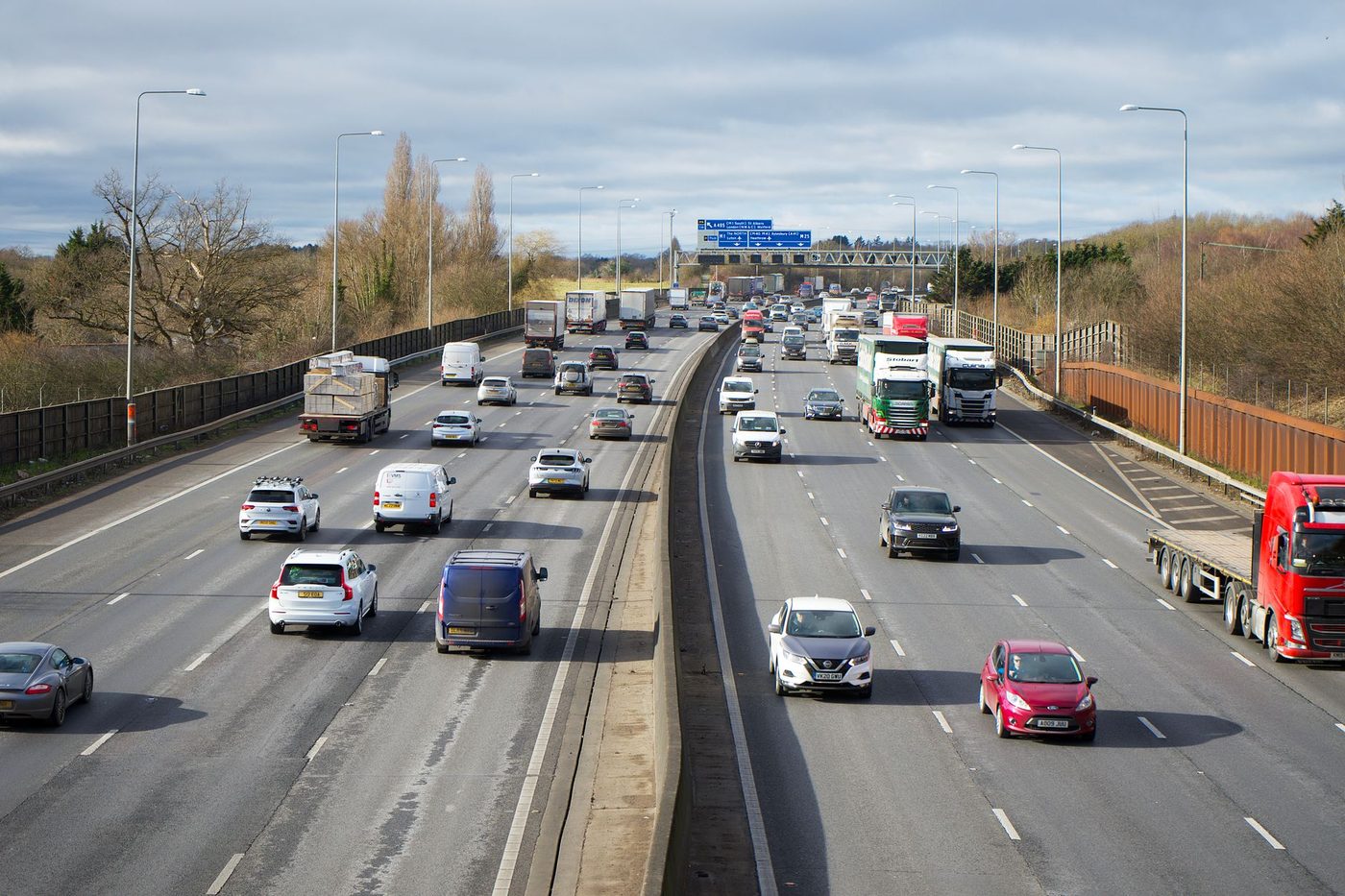
The Highway Code has a separate motorway section, rules 253 to 274, covering signals above the carriageway, the hard shoulder, lane use and the slip road. The Code’s introduction says it applies to England, Scotland and Wales, and that rules using the words MUST or MUST NOT are legal requirements, while other rules use advisory wording such as “should”. The pages were read on 1 November 2026. This guide follows a motorway journey in order and is general information, not a substitute for lessons.
Who may use a motorway at all
Rule 253 lists road users who MUST NOT use motorways, including pedestrians, cyclists, horse riders, holders of provisional motorcycle licences, and riders of motorcycles under 50 cc (4 kW).
For learners, the same rule says provisional car licence holders MUST NOT drive on the motorway unless they are accompanied by a DVSA Approved Driving Instructor (ADI) and are driving a car displaying red L plates (or D plates in Wales) with dual controls.
Signals above the lanes
Rule 257 says amber flashing lights warn of a hazard ahead and that drivers should reduce speed, be prepared for the hazard and only increase speed when they pass a signal that is not flashing, or a sign showing a national speed limit or the word “END”, and are sure it is safe.
Rule 258 says red flashing light signals and a red “X” identify a closed lane in which people, stopped vehicles or other hazards are present. Drivers MUST NOT drive in a closed lane. Where all lanes are shown closed, the road is closed: drivers MUST NOT go beyond the sign in any lane or use the hard shoulder to avoid the closure unless directed by a police or traffic officer. The rule adds that closures shown by red flashing lights are enforced by the police.
Joining from the slip road
Rule 259 says that when joining, drivers should give priority to traffic already on the motorway, check the traffic and match their speed to fit safely into the traffic flow in the left-hand lane, and stay on the slip road if it continues as an extra lane. They should not use the hard shoulder, and should remain in the left-hand lane long enough to adjust to the speed of traffic before considering overtaking.
Speed, gaps and tiredness once on the road
Rule 261 says drivers MUST NOT exceed a speed limit displayed within a red circle on a sign, or the maximum speed limit for the road and for their vehicle. Rule 260 says to keep a safe distance from the vehicle in front and to increase the gap on wet or icy roads or in fog. Rule 126, elsewhere in the Code, says to allow at least a two-second gap on high-speed roads, at least doubled on wet roads and up to ten times greater on icy roads.
Rule 262 says the monotony of motorway driving can make a driver sleepy and points to the advice in Rule 91 on being fit to drive and taking breaks. Rule 263 says drivers MUST NOT reverse along any part of a motorway, including slip roads, hard shoulders and emergency areas, cross the central reservation or drive against the traffic flow; a driver who has missed the exit should carry on to the next one.
Lanes and overtaking
- Rule 264: keep in the left lane unless overtaking, and return to it when it is safe to do so.
- Rule 265: the right-hand lane of a motorway with three or more lanes MUST NOT be used (except in prescribed circumstances) by any vehicle drawing a trailer, or by the heavier goods and passenger vehicles the rule lists.
- Rule 267: overtake only on the right, and only when it is sure to be safe and legal. The checklist includes mirrors and a quick sideways glance into the blind spot.
- Rule 268: do not overtake on the left or weave in and out of lanes. In congested conditions where adjacent lanes move at similar speeds, a driver may keep up with the traffic in their own lane even if that means passing traffic in the lane to the right.
Hard shoulder, emergency areas and stopping
Rule 269 says a hard shoulder MUST NOT be used except in an emergency or if directed by the police, traffic officers or a traffic sign. Where it is used as an extra lane, it can only be used when a speed limit is shown above it; a red “X” or blank sign means it MUST NOT be used except in an emergency. Rule 270 says emergency areas MUST only be used in an emergency and are marked by blue signs with an orange SOS telephone symbol, and may have orange surfacing.
Rule 271 says drivers MUST NOT stop on any carriageway, emergency area, hard shoulder, slip road, central reservation or verge except in an emergency, or when told to do so by the police, traffic officers, an emergency sign or red flashing light signals. It adds not to stop on a motorway to make or receive mobile telephone calls, except in an emergency. Rule 272 says drivers MUST NOT pick up or set down anyone, or walk on a motorway, except in an emergency.
Leaving the motorway
Rule 273 says that, unless signs show a lane leading directly off the motorway, drivers normally leave by a slip road on the left, and should watch for signs, move into the left-hand lane well before the exit, signal left in good time and reduce speed on the slip road as necessary. Rule 274 warns that after leaving a motorway, speed may be higher than a driver realises: 50 mph may feel like 30 mph.
The bottom line
The Code’s introduction says it applies to England, Scotland and Wales, with MUST and MUST NOT marking legal requirements. A provisional car licence holder may use a motorway only with an ADI in a car with red L plates (D plates in Wales) and dual controls, as Rule 253 states. Rule 270 points to Rule 277 for a vehicle that develops a problem on the motorway, and that rule is not covered here.
Sources
- The Highway Code: Motorways (253 to 274), GOV.UK, public update date 14 September 2021, read 1 November 2026 (gov.uk)
- The Highway Code: General rules, techniques and advice for all drivers and riders (103 to 158), GOV.UK, public update date 17 September 2023, read 1 November 2026 (gov.uk)
- The Highway Code: Introduction, GOV.UK, public update date 1 July 2022, read 1 November 2026 (gov.uk)